What Determines Personal Loan Interest Rates? Key Factors Borrowers Should Compare
When you need a personal loan, the interest rate is the number you notice. But the final amount depends on several things including your credit history, income, existing EMIs, loan amount, tenure, lender pricing and fees.Therefore, when you are comparing the interest rates on personal loans, the better thing to do is to consider the total borrowing cost rather than the lowest advertised rate.
What Influences Personal Loan Interest Rates?
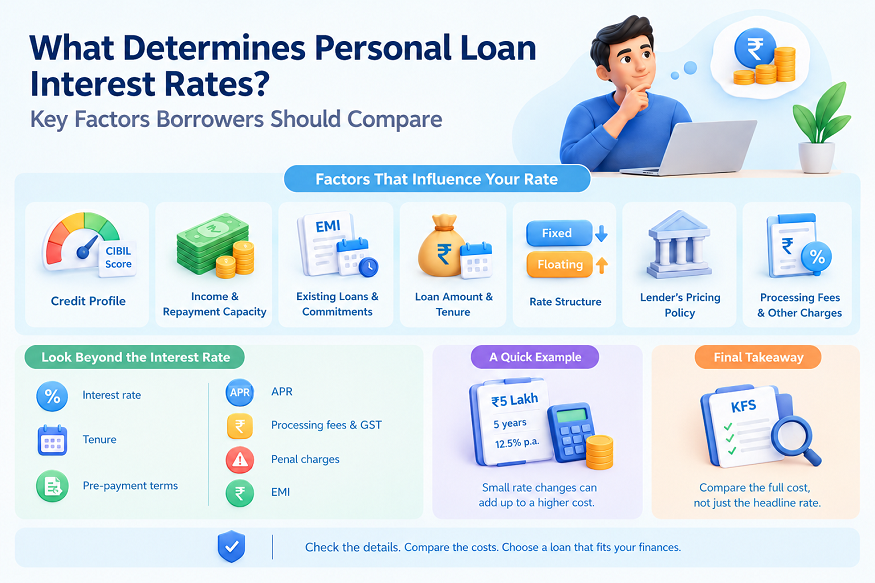
Lenders consider credit history and profile, repayment capacity, existing loans, loan amount and tenure, rate structure, pricing policy and applicable charges. For applicable retail term loans, RBI’s framework also requires a Key Facts Statement (KFS) with information such as APR and the amortisation schedule.
1. Credit Profile Matters
Your credit history shows how you have handled borrowing. Credit Information Companies’ data, income and existing obligations may be considered during assessment. A CIBIL score can influence the offer, but does not guarantee a particular rate. Before you apply, make sure that your report has no overdue accounts, errors, or duplicate entries.
2. Income and Existing EMIs
People who have similar salaries might be given different loan offers since their financial commitments could be different. When deciding on a loan, lenders look at whether the suggested EMI can be afforded in light of the borrower’s existing EMIs and other obligations. The amount of income, the type of job or employment situation, and the ability to make repayments can all influence the loan decision and the price charged.
3. Loan Amount and Tenure
Although a longer tenure makes it easier to manage the EMI, it generally means that you have to pay interest for a longer period, whereas a shorter tenure reduces the total amount of interest but increases the EMI, provided the principal and the rate stay the same.
For instance, if you take a loan of ₹5 lakh for five years at a rate of 12.5 per cent, your approximate monthly instalment (EMI) will be ₹11,249 with a total interest of ₹1.75 lakh; but when the rate goes up to 13.5 per cent, the EMI rises to about ₹11,505 and the total interest becomes ₹1.90 lakh.
4. Fixed or Floating Rate
A fixed rate generally remains unchanged under the agreed terms, while floating rate is linked to an external benchmark, so changes can affect the applicable rate, subject to the agreement and reset mechanism. RBI’s framework also requires lenders communication on rate changes for applicable floating-rate EMI-based personal loans.
5. Lender Prices Loans Differently
There is no single personal loan interest rate for everyone. Each of the banks and NBFCs use their own pricing and risk-assessment policies. When comparing personal loan interest rates, look at the actual offer and do not rely only the advertised rate.
Look Beyond the Interest Rate:
While comparing personal loan bank interest rates or different personal loan rates, consider:
| What to compare | Why it matters |
| Interest rate | Determines the interest charged on the outstanding loan |
| APR | Gives a broader view the annualised cost of credit |
| Fees/GST | May increase certain service-related costs |
| EMI and tenure | Affect monthly repayment commitment and total interest |
| Pre-payment/penal charges | Show applicable costs or conditions |
What About Processing Fees and GST?
Interest on loans is generally treated differently under GST, certain processing, documentation or other service-related fees may attract GST depending on the nature of the charge. The practical takeaway is simple: don’t look only at the interest rate and check the lender’s current fee schedule and the applicable tax treatment before accepting the loan.
Don’t Ignore Pre-Payment and Penal Charges
Learn what the terms for early repayment and missed obligations are.For applicable floating-rate loans to individuals for non-business purposes, no pre-payment charges apply to loans sanctioned or renewed from 1 January 2026, subject to the applicable conditions. Check the loan documents and KFS.
When Should You Be Particularly Careful?
Look closely if existing EMIs consume a significant part of your income, the final rate is higher than expected, or fees are unclear. Do not choose a long tenure only because the EMI looks comfortable.
Final Takeaway
A personal loan should not be judged by its interest rate alone. Credit worthiness and ability to pay determine the offer, whereas amount, term, charges, and pricing structure determine the cost. Read the KFS and compare APR, EMI, total repayment and applicable charges before accepting an offer.
Disclaimer: This article is for general educational purposes only and is not personalised financial, lending, legal or tax advice. Terms, rates, charges and eligibility may vary. Review lender documents before borrowing.